Your Excellence, Ladies and Gentlemen,
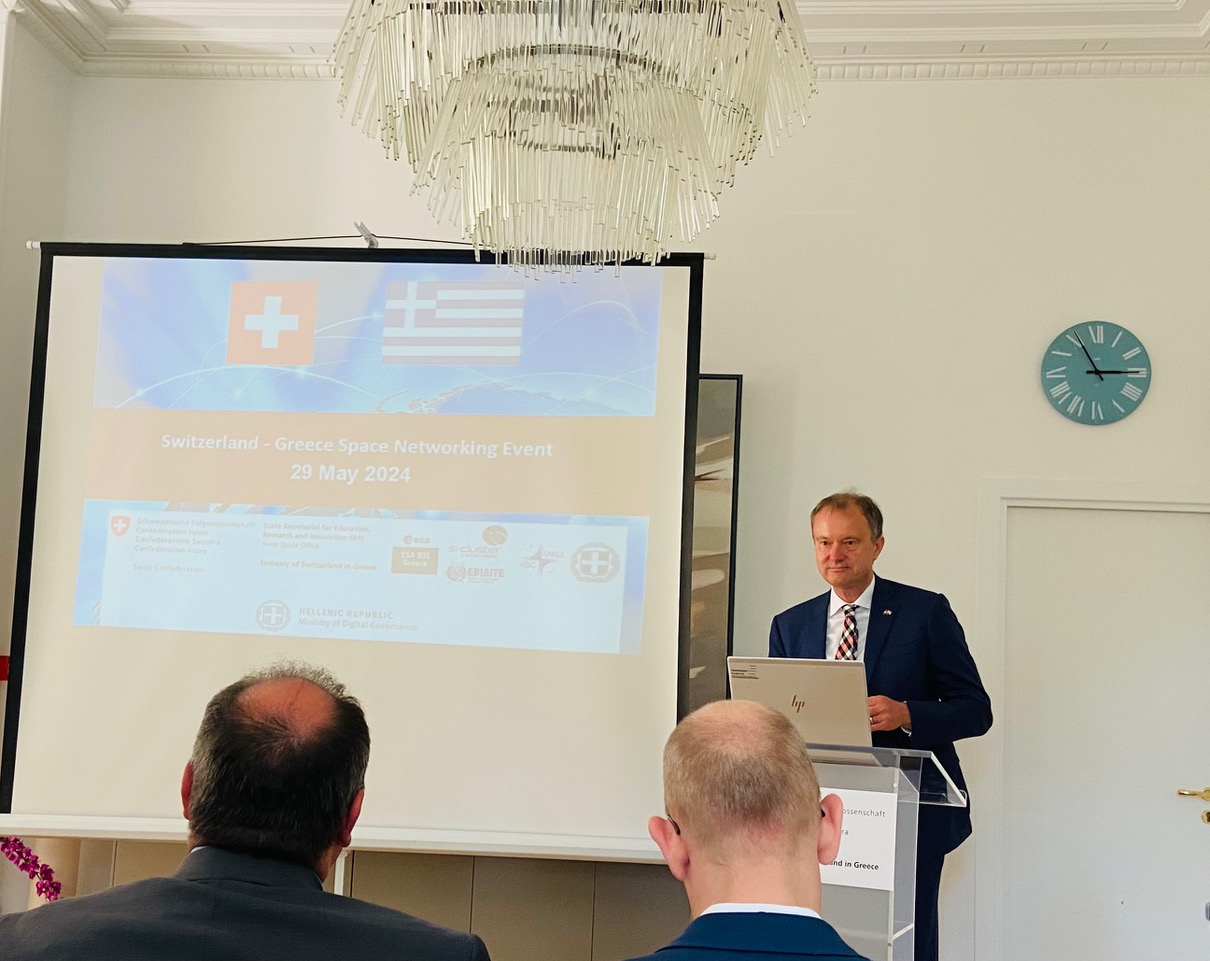
I am very happy and deeply honored to address you today, in my capacity as the president of the Greek Space Agency.
Before presenting the activities of the HSC, let us recollect a historic moment for space and for Switzerland: the so-called Swiss flag experiment.
It is a little-known fact that the first ‘flag’ on the Moon was Swiss. The team behind Apollo 11 Solar Wind Composition Experiment was from the University of Bern in Switzerland. The flag-like Solar Wind Composition Experiment was the first experiment set up by the Apollo 11 astronauts on the lunar surface, and its Principal Investigator was Johannes Geiss, the world-leading Swiss physicist.
The experiment was both simple and of great scientific value. It was carried on almost all lunar landing missions (except for Apollo 17), and it was the only non-American experiment to be part of the Apollo landings. It consisted of an aluminum foil sheet fixed to a pole facing the Sun.
By combining scientific arguments and diplomacy, Johannes Geiss even succeeded in convincing NASA to deploy the Swiss solar sail before unfurling the US flag, in order to maximise the foil’s exposure time.
Geiss was one of the main architects of the space science programme in Switzerland, and perhaps his most important contribution came late in his career through his creation and leadership of ISSI - the International Space Science Institute in Bern.
Which brings me to one of the two personal relations that I have with Switzerland, namely my participation in many workshops and forums that took place at ISSI in Bern. The other relation is through my eldest son, who did his PhD at EPFL Lausanne.
Let me now move to the Hellenic Space Center – the national Greek Space Agency.
The Hellenic Space Center operates for the public interest under the Ministry of Digital Governance. Among its responsibilities I can mention the formulation of the national space strategy, which is currently being completed, the supervision and coordination of space-related R&D activities to strengthen the national space capacity, and the forging of bilateral relations with counterpart space agencies of other countries.
As we all know, Greece is advancing rapidly in the space sector, currently designing, constructing, and preparing to deploy its first constellation of EO satellites. The initial launches are slated for 2025, with the entire constellation of over 15 satellites expected by 2026. This initiative aims to boost Greece’s strategic autonomy and technological sovereignty in space, addressing critical governmental, societal, environmental, and climate-related needs.
The Greek Space Agency and the Ministry of Digital Governance are spearheading the development of this advanced satellite constellation. The small satellites will feature cutting-edge payloads and high-resolution cameras for daily land and marine environment observation. Thermal payloads will detect and monitor wildfires, providing vital data to firefighting teams.
Additionally, synthetic aperture radar satellites will offer continuous, weather-independent monitoring to safeguard borders and detect floods, while multispectral sensors will monitor water quality, map agricultural areas, track crop growth, survey urban environments, and detect illegal constructions.
The implementation of this space program is crucial for the ability of Greece to manage natural disasters and monitor environmental changes effectively, ensuring the protection of natural habitats, properties, and lives. The space program also fosters economic growth by stimulating local high-tech industries, creating jobs, retaining skilled professionals, and attracting talent. Developing advanced satellite technology will support a sustainable economic framework, integrating science and technology sectors to enhance long-term economic resilience.
Greece is committed to advancing its strategic autonomy in space, as outlined in the forthcoming Greek Space Strategy. The program supports academic teams renowned for their expertise in space sciences, contributing to global efforts in space weather forecasting and solar system exploration. Collaboration with international scientific alliances and the domestic space industry enhances Greece’s scientific capabilities, positioning the country as a valuable player in the global space community.
With strategic partnerships, clear goals, and a commitment to excellence, Greece is well-positioned to achieve major advancements in space exploration, establishing a strong presence in the international space community.
Space science and exploration are vital for several reasons. They drive technological innovation, leading to advancements that benefit various industries on Earth. Exploring space helps us understand fundamental scientific questions about the universe and our place in it. It also enhances our ability to monitor and address global challenges such as climate change, natural disasters, and resource management. Investing in space science fosters international collaboration, promotes economic growth, and inspires future generations to pursue careers in science, technology, engineering, and mathematics (STEM). Through space exploration, humanity extends its reach, seeking knowledge and opportunities that can transform our world.